



Why US Companies Need Zero Trust Security Models

Share

Why The Need for Zero Trust Security Models
The traditional cybersecurity model was built around a simple assumption: keep attackers outside the corporate network, and the people and devices inside can generally be trusted.
That assumption no longer matches how American businesses operate.
US companies now depend on cloud applications, remote employees, personal devices, third-party vendors, software-as-a-service platforms, APIs, artificial intelligence systems, and distributed data environments. Employees can access corporate resources from homes, airports, coffee shops, mobile phones, and personal computers. Business applications may run across several cloud providers rather than inside a company’s own data center.
At the same time, cybercriminals are exploiting stolen credentials, software vulnerabilities, social engineering, compromised suppliers, and increasingly automated attack techniques.
This is where Zero Trust security becomes important.
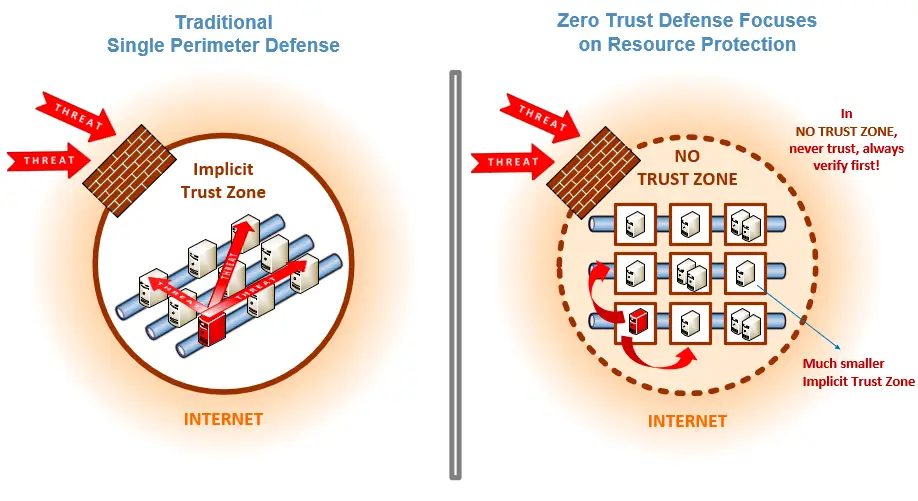
Zero Trust is a cybersecurity approach based on the principle that no user, device, application, or connection should receive implicit trust simply because it is inside a corporate network. Access should be continuously evaluated according to identity, device security, context, resource sensitivity, and risk.
The National Institute of Standards and Technology, or NIST, formally describes Zero Trust Architecture in Special Publication 800-207. NIST explains that Zero Trust moves security away from relying primarily on network location and toward protecting individual resources, users, devices, applications, and data.
For US companies dealing with increasingly distributed technology environments, Zero Trust is becoming less of a theoretical cybersecurity concept and more of an architectural approach to controlling access and limiting the damage caused when something goes wrong.
What Is Zero Trust Security?
Zero Trust is a security model based on the idea of “never trust, always verify.”
However, this phrase should not be interpreted as simply asking employees for passwords every time they open an application.
A mature Zero Trust architecture continuously evaluates whether a particular access request should be allowed.
For example, a company could evaluate:
- Who is requesting access?
- What device are they using?
- Is the device managed by the organization?
- Is the device compliant with security policies?
- What application is being accessed?
- What data is being requested?
- Where is the request originating?
- Is the behavior consistent with the user’s normal activity?
- How sensitive is the requested resource?
- Does the employee actually need this level of access?
Instead of assuming that an authenticated employee is trustworthy, the organization evaluates the request itself.
This represents a major change from traditional perimeter-based security.
Why the Traditional Corporate Perimeter Is No Longer Enough
For decades, businesses invested heavily in firewalls, VPNs, network segmentation, antivirus software, and other perimeter defenses.
These controls remain useful, but the corporate perimeter has become increasingly difficult to define.
A modern US company might have:
| Environment | Example |
|---|---|
| Corporate network | Office computers and internal systems |
| Cloud infrastructure | AWS, Microsoft Azure or Google Cloud |
| SaaS applications | Microsoft 365, Salesforce or other business platforms |
| Remote workforce | Employees working outside the office |
| Mobile devices | Smartphones and tablets |
| Third parties | Contractors, suppliers and service providers |
| APIs | Connections between applications and services |
| AI systems | Enterprise AI tools and automated agents |
| Personal devices | BYOD computers and smartphones |
NIST specifically identifies remote users, bring-your-own-device environments, and cloud-based assets as important reasons traditional network boundaries have become less effective.
A firewall can protect a network boundary.
It cannot, by itself, determine whether an employee should download 50,000 customer records at 2 a.m. from an unmanaged device.
That requires identity, context, authorization, monitoring, and data-level controls.
The 2026 Cybersecurity Environment Makes Zero Trust More Relevant
The threat landscape facing American organizations continues to evolve.
Verizon’s 2026 Data Breach Investigations Report found that exploitation of vulnerabilities accounted for 31 percent of breaches analyzed, making it the leading initial access vector in the report. Verizon also reported a 40 percent increase in successful mobile social engineering and said third-party supply chain breaches increased by 60 percent, reaching 48 percent of breaches in its dataset.
These findings demonstrate why companies cannot build their security strategy around the assumption that a single defensive layer will keep attackers out.
A vulnerability can provide initial access.
A compromised employee account can provide another route.
A supplier can introduce additional risk.
A stolen session token can potentially allow access without a traditional password.
Zero Trust addresses this problem by reducing the amount of access available after an identity, device, application, or network component becomes compromised.
Zero Trust and the Principle of Least Privilege
One of the most important concepts behind Zero Trust is least-privilege access.
Employees should receive the minimum level of access required to perform their responsibilities.
Consider a fictional US financial services company.
An employee in marketing might need access to:
- Marketing analytics
- Advertising platforms
- Customer campaign data
- Content management systems
That employee probably does not need unrestricted access to:
- Payroll databases
- Customer authentication records
- Production server credentials
- Financial transaction systems
Traditional environments can sometimes accumulate excessive permissions over time.
An employee changes departments, receives additional permissions, joins a new project, or retains access to systems that are no longer required.
Zero Trust encourages organizations to continuously review these permissions.
The objective is simple: if an account is compromised, the attacker should not automatically receive access to everything that account could theoretically reach.
How Zero Trust Limits Lateral Movement
One of the most dangerous consequences of a successful cyberattack is lateral movement.
An attacker initially compromises one account or device. From there, they attempt to move through the organization until they reach more valuable systems.
For example:
Compromised employee account → internal application → privileged account → database → sensitive customer information
Traditional network trust can make this movement easier when internal systems implicitly trust one another.
Zero Trust attempts to interrupt this chain.
Each additional resource can require authorization based on identity, device posture, context, policy, and other signals.
This does not mean Zero Trust makes lateral movement impossible.
Rather, the architecture is designed to make unauthorized movement more difficult and limit the blast radius of a compromise.
NIST describes Zero Trust Architecture as an approach designed to protect resources and limit internal lateral movement rather than simply defending a broad network perimeter.
Zero Trust Is Particularly Important for Remote Work
Remote work has permanently changed enterprise security.
An employee working from a company office may connect through corporate infrastructure. A remote employee could be connecting from a home network, hotel, airport, coworking space, or another country.
The organization cannot reasonably assume that the network itself is trustworthy.
Zero Trust therefore shifts attention toward the user, device, application, and resource.
For example, an organization could require:
- Strong authentication
- Device verification
- Multi-factor authentication
- Device health checks
- Conditional access
- Application-level authorization
- Continuous monitoring
If an employee’s credentials are stolen, additional controls can potentially prevent the attacker from accessing sensitive resources.
Zero Trust and Cloud Security
Cloud computing is another major reason companies are adopting Zero Trust principles.
A company’s information may now be distributed across multiple cloud environments and SaaS platforms.
NIST’s cloud-native Zero Trust guidance emphasizes identity-based controls for users, applications, and services across multi-cloud environments.
This is important because modern applications increasingly communicate with one another through APIs and service identities.
Security teams therefore need to consider not only human users but also machines, applications, APIs, workloads, and automated systems.
An application should not automatically receive unlimited access simply because it is operating inside a trusted cloud environment.
Zero Trust and Artificial Intelligence
The rapid adoption of AI creates another reason for organizations to reconsider access controls.
Employees increasingly use AI systems to process documents, summarize information, generate code, analyze data, and automate business processes.
At the same time, organizations are deploying AI agents and integrating AI into internal applications.
This creates new questions:
- Which AI systems can access company data?
- Which employees can submit confidential information to AI tools?
- Can an AI agent access production systems?
- What permissions should an AI application have?
- Can an automated system retrieve sensitive customer information?
- How are AI service accounts monitored?
- What happens if an AI credential is compromised?
Zero Trust provides a useful architectural foundation because access can be based on identity and policy rather than simply network location.
This becomes particularly important as non-human identities become more common inside enterprise environments.
Zero Trust Can Strengthen Data Protection
Zero Trust is not exclusively a network security strategy.
It can also support data protection.
Organizations hold enormous quantities of personal and business information, including:
- Names
- Email addresses
- Financial information
- Customer records
- Employee information
- Authentication credentials
- Health-related information
- Intellectual property
- Business contracts
- Strategic documents
A company does not need to wait until data leaves its environment before considering whether access was appropriate.
Zero Trust encourages organizations to determine who should access sensitive information and under what circumstances.
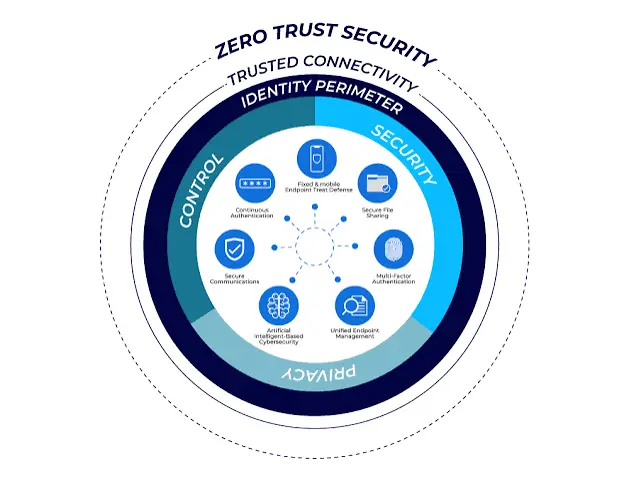
This creates an important connection between cybersecurity and privacy.
A security architecture that reduces unnecessary access can also reduce the number of people, devices, applications, and services capable of reaching sensitive data.
Zero Trust and Third-Party Risk
US companies rarely operate entirely alone.
They depend on vendors, consultants, technology providers, contractors, managed service providers, software suppliers, and business partners.
This creates an additional security challenge.
A company may have strong internal security controls but still face risks introduced through a third party.
Zero Trust can help organizations restrict third-party access to specific applications and resources rather than providing broad network access.
For example, a contractor working on a specific application may only require access to that application.
There may be no legitimate reason for the contractor to access the company’s entire internal network.
This is especially relevant given the increase in third-party and supply chain breaches reported in Verizon’s 2026 DBIR.
Five Core Components of a Zero Trust Strategy
A practical Zero Trust program should not begin by purchasing a single security product.
It should begin with an architecture and governance strategy.
1. Identity
Organizations need strong identity management.
This includes:
- Multi-factor authentication
- Single sign-on
- Identity governance
- Privileged access management
- Strong authentication
- Lifecycle management
Every user should have an identifiable digital identity.
2. Device Security
Organizations should understand which devices are accessing corporate resources.
Important controls can include:
- Device management
- Endpoint detection and response
- Encryption
- Patch management
- Security configuration
- Device compliance checks
A valid username should not automatically make an insecure device trustworthy.
3. Application Security
Applications should enforce authorization according to business requirements.
Companies should know which applications communicate with sensitive systems and which identities can access them.
4. Data Protection
Sensitive data should receive appropriate protection through:
- Access controls
- Encryption
- Data classification
- Data loss prevention
- Monitoring
- Retention policies
5. Continuous Monitoring
Zero Trust depends heavily on visibility.
Organizations need to monitor authentication events, devices, applications, network activity, privileged accounts, and unusual behavior.
Security decisions become stronger when they are based on current information rather than assumptions.
Zero Trust Does Not Mean “Trust Nobody”
The phrase “never trust, always verify” can sometimes create confusion.
Zero Trust does not mean that employees should be treated as criminals or that organizations should constantly interrupt legitimate business activity.
The objective is controlled access based on risk.
A low-risk request to access a public internal document may require relatively few controls.
A request to access a sensitive financial database from an unfamiliar device should receive considerably more scrutiny.
In other words, Zero Trust is not about making every action difficult.
It is about applying appropriate security controls to the sensitivity and risk of the requested resource.
A Practical Zero Trust Implementation Roadmap for US Companies
Companies do not necessarily need to transform their entire infrastructure overnight.
A phased approach can be more practical.
Phase 1: Discover
Identify:
- Users
- Devices
- Applications
- Data
- Privileged accounts
- Cloud services
- Third parties
Phase 2: Secure Identity
Implement strong authentication and eliminate unnecessary privileged accounts.
Phase 3: Enforce Least Privilege
Review permissions and remove access that employees, applications, and vendors no longer require.
Phase 4: Strengthen Devices
Ensure devices meet minimum security requirements before accessing sensitive systems.
Phase 5: Segment Critical Resources
Separate highly sensitive systems and databases from ordinary business applications.
Phase 6: Monitor Continuously
Collect security signals and investigate unusual access patterns.
Phase 7: Automate Where Appropriate
Use policy engines and automated security controls to respond rapidly to high-risk events.
NIST’s implementation guidance demonstrates that Zero Trust can be implemented across hybrid environments and provides practical examples for organizations developing their architectures.
Zero Trust vs Traditional Security
| Security Approach | Traditional Perimeter Model | Zero Trust Model |
|---|---|---|
| Main security boundary | Network | Resource and identity |
| Internal users | Often implicitly trusted | Continuously evaluated |
| Remote workers | VPN-centric | Identity and context-based access |
| Device security | Secondary consideration | Important access signal |
| Access | Broad network access may occur | Granular resource access |
| Data protection | Network-focused | Data and resource-focused |
| Third parties | Often broad connectivity | Restricted access |
| Lateral movement | Can be difficult to contain | Designed to limit movement |
| Cloud environments | Added complexity | Identity-centric controls |
| AI systems | Emerging challenge | Explicit identity and authorization requirements |
The difference is fundamentally architectural.
Traditional security often asks:
Is this user inside the network?
Zero Trust asks:
Should this specific user, device, application, or service have access to this specific resource under these circumstances?
Common Zero Trust Mistakes
Zero Trust implementation can fail if organizations treat it as a marketing term rather than a security architecture.
Common mistakes include:
Buying Technology Without an Architecture
Purchasing an identity product or security platform does not automatically create Zero Trust.
Ignoring Privileged Accounts
Administrative identities can have enormous access. They require particularly strong controls.
Forgetting Non-Human Identities
Applications, APIs, service accounts, bots, and AI agents also require authentication and authorization.
Focusing Only on Networks
Zero Trust should extend beyond network segmentation to identities, applications, devices, and data.
Making Access Too Complicated
Security controls that unnecessarily disrupt employees can encourage workarounds.
The goal should be secure access that remains usable.
What Zero Trust Means for US Business Leaders
For executives, Zero Trust should not be viewed purely as an IT project.
It is fundamentally about managing business risk.
A compromised account, vulnerable application, or third-party supplier can potentially become a pathway into valuable corporate resources.
The question for leadership is therefore not simply whether the organization has a firewall, antivirus software, or VPN.
The more important questions are:
Who has access to our most sensitive resources?
Why do they have that access?
Are their devices secure?
Can compromised credentials be detected quickly?
Can an attacker move from one system to another?
Can access be automatically restricted when risk changes?
These questions move cybersecurity from perimeter defense toward continuous risk management.
Frequently Asked Questions About Zero Trust Security
What is Zero Trust security?
Zero Trust is a cybersecurity model that does not automatically trust users, devices, applications, or network connections based solely on their location or ownership. Access is evaluated according to identity, context, security posture, resource sensitivity, and policy.
Why do US companies need Zero Trust?
US companies increasingly operate across cloud environments, remote workplaces, mobile devices, SaaS platforms, APIs, third-party services, and AI systems. These environments make a single traditional network perimeter less effective.
Does Zero Trust replace firewalls?
No. Zero Trust does not necessarily replace firewalls, endpoint security, encryption, identity management, or other security controls. It changes how those controls are organized around identity, resources, risk, and access decisions.
Does Zero Trust prevent data breaches?
No cybersecurity architecture can guarantee that a company will never experience a breach. Zero Trust is designed to reduce unauthorized access and limit the potential impact and lateral movement associated with compromises.
Is Zero Trust only for large corporations?
No. The principles can also be applied by small and medium-sized businesses. Smaller organizations can begin with strong identity controls, multi-factor authentication, least privilege, device management, and protection of their most sensitive resources.
How does Zero Trust help remote employees?
It allows companies to evaluate access based on identity, device security, application, resource, and other contextual signals rather than assuming that an employee is safe simply because they connected through a corporate network.
Does Zero Trust protect personal data?
Zero Trust can support data protection by limiting access to sensitive information and requiring stronger authorization around valuable resources. It should be implemented alongside privacy, governance, data classification, and other data protection measures.
How long does Zero Trust implementation take?
There is no universal timeline. Implementation depends on an organization’s size, infrastructure, applications, data environment, identity architecture, regulatory obligations, and security maturity. A phased approach is generally more practical than attempting to change everything simultaneously.
Final Thoughts
The cybersecurity perimeter of the modern American company is no longer defined by the walls of an office.
Employees work remotely. Applications run in the cloud. Vendors connect to corporate systems. Customers interact through APIs. Mobile devices access business services. Artificial intelligence is becoming integrated into workflows. Sensitive data moves across increasingly complex digital environments.
That reality requires a different security mindset.
Zero Trust provides a framework for moving away from implicit trust and toward continuous verification, least-privilege access, stronger identity controls, device awareness, resource-level authorization, and continuous monitoring.
For US businesses, the central question is no longer simply whether an organization can keep attackers outside its network.
It is whether the organization can prevent a compromised identity, device, application, vendor, or service from becoming a gateway to everything else.
That is the fundamental security problem Zero Trust is designed to address.
Sources and further reading:
NIST Zero Trust Architecture, SP 800-207
Verizon 2026 Data Breach Investigations Report
















Leave a Reply