



Your Child Asked an AI Toy a Personal Question. Where Does It Go?

Share
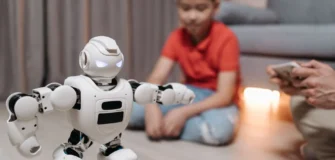
A mother in Lagos sits in her living room, watching her five-year-old son whisper a secret to a plush, talking bear. The boy asks, “What is my real name, and where do we live?” The toy responds with a cheerful, synthesized voice, perhaps even repeating a fragment of the answer. To the child, it is magic. To the parent, it is a moment of connection. But to a data privacy expert, it is a high-risk data transmission event.
When a child asked a toy a personal question, the information does not simply vanish into the air. It is captured by microphones, converted into digital packets, and sent across the internet to cloud servers. The path that data takes—and who has access to it—is often a black box for most families.
The Lifecycle of a Voice: From Playroom to Cloud
Modern AI-enabled toys rely on Natural Language Processing (NLP) and Large Language Models (LLMs) to function. For these toys to “understand” a child, they must be able to process speech. This process typically follows a specific technical journey:
- Capture: The toy’s onboard microphone detects a voice trigger.
- Transmission: The audio file or stream is sent via the home Wi-Fi to the manufacturer’s cloud servers.
- Transcription: The audio is converted into text using speech-to-text technology.
- Processing: The text is analyzed by an AI model to formulate a response.
- Storage: The interaction (voice, text, and metadata) is often stored in a database for model training or service improvement.
The danger lies in the “Storage” and “Processing” phases. If the manufacturer uses these interactions to train their AI, your child’s unique voice patterns and personal disclosures become part of a massive dataset. This is where the concept of data protection becomes critical.
The Hidden Risks of Smart Toys
The risks of interactive toys extend far beyond a simple leaked secret. They involve complex layers of digital vulnerability.
1. Data Profiling and Commercial Exploitation
When a child discloses their likes, dislikes, fears, or family details, they are inadvertently building a highly detailed consumer profile. If this data is shared with third-party advertisers or used to refine behavioral targeting, companies can create a “digital twin” of a child before they even enter primary school. This is a violation of the fundamental principle that children should not be targets of commercial manipulation.
2. The Security Vulnerability: When Toys Become Spies
Every connected device is an entry point into a home network. If a smart toy has weak security protocols, it can be hijacked by bad actors. A compromised toy could theoretically allow an attacker to listen to private household conversations, turning a source of comfort into a surveillance tool.
3. Secondary Data Use and Training Sets
Many AI companies include clauses in their Terms of Service that allow them to use “anonymized” data to improve their services. However, voice data is inherently difficult to truly anonymize. A child’s unique way of speaking can act as a biometric identifier, potentially linking their data back to their identity.
Comparing Global Privacy Frameworks for Children
Regulators worldwide are racing to catch up with the rapid deployment of AI toys. The level of protection a child receives often depends on where they live.
| Framework | Primary Jurisdiction | Key Focus for Children |
|---|---|---|
| COPPA | United States | Requires parental consent for collecting data from children under 13. |
| GDPR | European Union | Stricter rules on “age of consent” and the right to be forgotten. |
| NDPA | Nigeria | Emphasizes the protection of vulnerable subjects, including children, from data processing risks. |
While these laws provide a foundation, they often struggle with the speed of AI innovation. For instance, the FTC in the US has actively penalized companies for failing to secure children’s data, yet many toy manufacturers operate in gray areas regarding how much data is “necessary” for the toy to function.
Case Study: The “Secret Keeper” Scenario
Consider the case of “Leo,” a hypothetical six-year-old. Leo tells his AI robot, “My mommy and daddy are fighting about money, and I am scared.”
In a poorly regulated ecosystem, that sentence is transcribed, tagged with Leo’s device ID, and stored in a cloud database. Months later, that data might be used to train a sentiment analysis model. If that database suffers a breach, or if the data is sold to a broker, Leo’s sensitive family information is no longer private. It has transitioned from a private moment to a data point in a global economy.
“The issue is not just that children are sharing information; it is that they are sharing it with an entity that has no concept of privacy, and parents often lack the technical visibility to monitor that exchange.”
Actionable Steps: How to Protect Your Child’s Digital Footprint
As a parent or caregiver, you do not have to ban technology, but you must approach it with informed skepticism. Follow this checklist before bringing a smart toy into your home:
- Audit the Privacy Policy: Look for specific sections on “Children’s Privacy.” If the policy is written in dense legalese and doesn’t explicitly state how child data is handled, avoid the product.
- Check for Physical Mute Switches: The safest smart toy is one that can be physically disconnected from the microphone when not in use.
- Review Connectivity Requirements: Does the toy require a constant Wi-Fi connection and a linked account to function? If so, the data risk is significantly higher.
- Monitor the Interaction: Treat AI toys like any other social interaction. Sit with your child and listen to what they are saying to the device.
- Enforce compliance through settings: Many apps have “Privacy Mode” or “Limited Data Collection” settings. Ensure these are toggled on immediately after setup.
Frequently Asked Questions
Can I delete the data my child has already shared?
Most reputable companies provide a way to request data deletion. Check the privacy settings in the companion app or contact their data protection officer (DPO) directly.
Are all AI toys dangerous?
Not all. Many companies are adopting “Privacy by Design,” meaning they process voice data locally on the device rather than sending it to the cloud. Always look for “on-device processing” in product descriptions.
Conclusion
When a child asked a toy a personal question, they are engaging in a fundamental part of childhood: curiosity. Our responsibility as adults is to ensure that this curiosity does not come at the cost of their lifelong digital privacy. By understanding the data journey and demanding higher standards of transparency from manufacturers, we can enjoy the benefits of technology without sacrificing the sanctity of the playroom.
















Leave a Reply