



The World’s Most Powerful Data Protection Regulators

Share
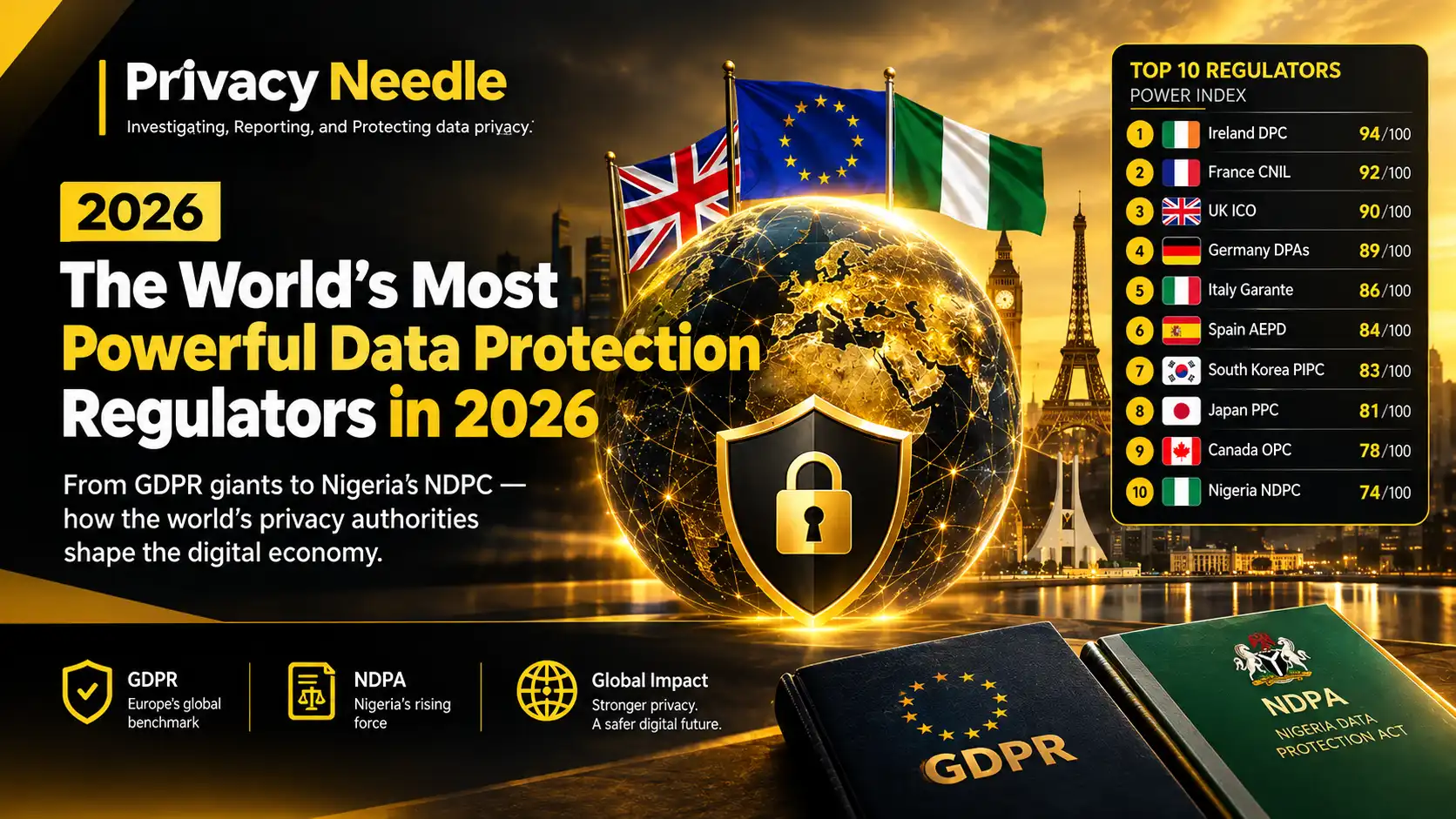
The World’s Most Powerful Data Protection Regulators 2026: From GDPR Giants to Nigeria’s NDPC
Personal data has become one of the most valuable assets in the global digital economy. It powers artificial intelligence systems, financial services, advertising platforms, healthcare technologies, social networks and increasingly sophisticated digital products.
But as the value of personal data has increased, so has the power of the regulators responsible for protecting it.
Today, data protection authorities can investigate some of the world’s largest technology companies, order organisations to change how they process personal information, restrict international data transfers and impose penalties worth hundreds of millions or even billions of dollars.
Europe remains the centre of gravity for global privacy enforcement because of the General Data Protection Regulation (GDPR). But powerful regulators also operate across Asia, North America and Africa.
Nigeria is part of that changing landscape.
The Nigeria Data Protection Commission (NDPC), established under the Nigeria Data Protection Act 2023, has moved from building the country’s modern privacy framework to exercising increasingly visible enforcement powers. Its ₦766.2 million penalty against MultiChoice Nigeria in 2025 demonstrated that Nigerian data protection enforcement is no longer merely theoretical.
So which regulators are the biggest and most powerful in 2026?
There is no universally accepted global ranking. “Biggest” can mean the largest budget, the greatest geographic reach, the largest fines, the highest number of investigations or the greatest international influence.
To provide a more useful comparison, Privacy Needle created the 2026 Global Data Protection Authority Power Index, measuring enforcement strength, regulatory reach, financial sanctions, investigative activity, international influence, technology and AI relevance, and data-subject protection.
The 2026 Global Data Protection Authority Power Index
| Rank | Regulator | Jurisdiction | Power Index |
|---|---|---|---|
| 1 | Irish Data Protection Commission (DPC) | Ireland / EU | 94/100 |
| 2 | CNIL | France / EU | 92/100 |
| 3 | Information Commissioner’s Office (ICO) | United Kingdom | 90/100 |
| 4 | German Data Protection Authorities | Germany / EU | 89/100 |
| 5 | Garante | Italy / EU | 86/100 |
| 6 | AEPD | Spain / EU | 84/100 |
| 7 | PIPC | South Korea | 83/100 |
| 8 | Japan PPC | Japan | 81/100 |
| 9 | Canada’s Privacy Commissioner system | Canada | 78/100 |
| 10 | Nigeria Data Protection Commission (NDPC) | Nigeria | 74/100 |
Important: The Power Index is an original Privacy Needle editorial ranking. It is not an official ranking published by any regulator or international organisation. Scores are intended to compare regulatory influence and enforcement capability, not to measure which authority is “better” at protecting privacy.
How the Power Index works
Privacy Needle scores regulators against eight factors:
- Enforcement power: 20 points
- Regulatory reach: 15 points
- Financial enforcement: 15 points
- Investigative activity: 10 points
- International influence: 10 points
- Technology and AI relevance: 10 points
- Data-subject protection: 10 points
- Institutional maturity: 10 points
This approach prevents the ranking from becoming simply a list of regulators with the largest fines.
1. Ireland’s Data Protection Commission

Ireland’s Data Protection Commission is arguably the most consequential individual GDPR regulator in the world.
The reason is not Ireland’s population. It is the country’s role as the European headquarters for many of the world’s largest technology companies.
Because many multinational technology companies establish European operations in Ireland, the Irish DPC has become responsible for some of the most important GDPR investigations involving companies such as Meta, TikTok, WhatsApp, LinkedIn and other global platforms.
The DPC was responsible for the €1.2 billion GDPR penalty against Meta, which remains the largest individual GDPR fine ever imposed. DLA Piper’s GDPR enforcement research has also shown that Ireland accounts for a disproportionate share of the largest GDPR penalties.
That makes the Irish regulator exceptionally important beyond Ireland itself.
Why Ireland ranks #1
- Major technology companies operate their European headquarters in Ireland.
- It has handled some of Europe’s largest technology investigations.
- Its decisions can affect companies and users across the European Economic Area.
- Its enforcement decisions contribute to wider European GDPR precedent.
- Its work frequently involves cross-border processing and international technology companies.
Power Index: 94/100
2. France’s CNIL

France’s Commission Nationale de l’Informatique et des Libertés, commonly known as CNIL, is one of the world’s oldest and most influential privacy regulators.
Unlike a regulator known primarily for a handful of enormous technology-company penalties, CNIL combines enforcement with extensive public guidance, investigations, policy development, cybersecurity work and emerging technology regulation.
Its 2025 figures demonstrate the scale of its operations.
CNIL carried out 323 investigations and issued 259 corrective measures, including 83 sanctions, with cumulative fines of approximately €486.84 million. It also received 20,150 complaints, a 10% increase from 2024.
CNIL has also become increasingly involved in the regulation of artificial intelligence.
Its importance therefore extends beyond traditional GDPR enforcement into AI governance, cybersecurity, cookies, employee monitoring, children’s privacy and digital rights.
Power Index: 92/100
3. United Kingdom Information Commissioner’s Office
The UK’s Information Commissioner’s Office (ICO) remains one of the world’s most recognisable privacy regulators.
The UK is no longer part of the European Union, meaning it operates under the UK GDPR and Data Protection Act 2018 rather than directly applying the EU GDPR.
However, the ICO retains enormous influence because of Britain’s size, financial sector, technology industry and international connections.
The regulator also has responsibilities extending beyond traditional personal-data protection, making it an important institution in the wider information-governance ecosystem.
Its influence is particularly important for organisations operating across the UK and European markets.
Power Index: 90/100
4. Germany’s Data Protection Authorities
Germany presents an unusual case.
Rather than having one single national regulator for all private-sector data protection matters, Germany has a federal authority, the Federal Commissioner for Data Protection and Freedom of Information (BfDI), alongside data protection authorities in the individual federal states.
This decentralised structure gives Germany a large and sophisticated regulatory ecosystem.
German regulators have historically taken privacy, employee monitoring, telecommunications, advertising and technology regulation seriously.
Germany’s enormous economy also means that its privacy decisions can have significant commercial consequences.
For the purposes of this ranking, Privacy Needle treats Germany’s federal and state authorities as a regulatory ecosystem, rather than pretending they are one organisation.
Power Index: 89/100
5. Italy’s Garante
Italy’s Garante per la protezione dei dati personali is another major European privacy authority.
The regulator has played an important role in enforcement involving digital platforms, artificial intelligence, cookies, marketing and sensitive personal information.
Italy’s regulator is particularly notable because privacy enforcement increasingly intersects with the country’s broader debates about artificial intelligence and emerging technologies.
Its position within the GDPR enforcement system also means its decisions can have implications beyond Italian borders.
Power Index: 86/100
6. Spain’s AEPD
Spain’s Agencia Española de Protección de Datos (AEPD) is another major European authority with substantial GDPR enforcement responsibilities.
Spain’s regulator has developed a reputation for active enforcement, particularly involving digital advertising, cookies, telecommunications and personal-data processing.
The country’s large population and sizeable digital economy provide the AEPD with a significant regulatory base.
Its role in European cross-border enforcement further increases its influence.
Power Index: 84/100
7. South Korea’s Personal Information Protection Commission

Asia’s privacy landscape is increasingly important, and South Korea’s Personal Information Protection Commission (PIPC) is one of the region’s strongest regulators.
South Korea has a sophisticated technology economy, major internet companies and a highly developed digital infrastructure.
The country’s privacy framework is centred around the Personal Information Protection Act (PIPA).
The PIPC’s importance is likely to increase as artificial intelligence, biometric information, digital platforms and cross-border data transfers become more important.
The regulator also provides formal channels through which individuals can report infringements involving personal information.
Power Index: 83/100
8. Japan’s Personal Information Protection Commission

Japan’s Personal Information Protection Commission (PPC) is another major Asia-Pacific privacy regulator.
Japan’s Act on the Protection of Personal Information (APPI) creates the country’s principal framework for personal-data protection.
Japan’s position as a major technology and economic power makes its privacy regulator increasingly relevant to international businesses.
Its regulatory importance is also growing as Japanese companies participate more heavily in artificial intelligence, cloud computing, digital finance and international data flows.
Power Index: 81/100
9. Canada’s Privacy Commissioner System
Canada uses a different regulatory structure from the European Union.
At the federal level, the Office of the Privacy Commissioner of Canada (OPC) plays a central role in privacy oversight, while provincial authorities also have important responsibilities.
Canada’s federal privacy framework includes PIPEDA for private-sector organisations and the Privacy Act for federal government institutions, alongside provincial privacy laws.
Canada is particularly important for companies involved in international data processing because of its strong privacy relationship with European markets.
Power Index: 78/100
10. Nigeria’s Data Protection Commission
Nigeria’s position in this ranking deserves special attention.
The Nigeria Data Protection Commission (NDPC) is younger than most of the European authorities on this list, but its development has been rapid.
The Commission was established under the Nigeria Data Protection Act 2023, which created a dedicated institutional framework for data protection in Nigeria. The law applies to organisations domiciled, resident or operating in Nigeria, processing personal data within Nigeria, and certain organisations outside Nigeria processing the personal data of Nigerian data subjects.
The NDPC is therefore not simply a Nigerian version of an old-fashioned privacy office.
It has responsibility for regulating a rapidly digitising economy containing banking platforms, fintech companies, telecommunications operators, technology companies, healthcare organisations, educational institutions, e-commerce platforms and government agencies.
NDPC’s enforcement power
The NDP Act provides for significant administrative sanctions.
According to the NDPC’s published guidance, a Data Controller or Processor of Major Importance can face a penalty or remedial fee up to the greater of ₦10 million or 2% of annual gross revenue from the preceding financial year.
For controllers or processors that are not of major importance, the corresponding maximum is the greater of ₦2 million or 2% of annual gross revenue, subject to the Act’s provisions.
The Commission has demonstrated that these provisions can have real financial consequences.
In 2025, the NDPC imposed a ₦766,242,500 administrative penalty on MultiChoice Nigeria following an investigation that included issues around personal-data processing and cross-border transfers.
The Commission has also reported that Nigeria’s data-protection sector had grown to approximately ₦16.2 billion, while the Commission had generated more than ₦2 billion over its first two years.
Those numbers matter because they demonstrate that privacy regulation in Nigeria is becoming an economic sector rather than merely a compliance obligation.
Power Index: 74/100
Why Nigeria’s NDPC Is Not Yet in Europe’s Top Tier
Ranking NDPC tenth does not mean Nigeria has weak data protection regulation.
It reflects something much simpler: regulatory maturity and historical enforcement scale.
The Irish DPC, CNIL and other European authorities have been operating within mature privacy ecosystems for many years. GDPR enforcement has produced billions of euros in penalties and an enormous body of regulatory decisions.
The NDPC’s modern institutional framework dates from 2023.
It would therefore be misleading to compare the NDPC’s cumulative enforcement history directly with an authority such as Ireland’s DPC.
The more interesting question is where the NDPC could be in five or ten years.
That is where Nigeria becomes particularly significant.
NDPA vs GDPR: How Does Nigeria Compare?
The Nigeria Data Protection Act and the European Union’s GDPR share many principles, but they are not identical laws.
| Area | EU GDPR | Nigeria Data Protection Act |
|---|---|---|
| Main framework | General Data Protection Regulation | Nigeria Data Protection Act 2023 |
| Main regulatory structure | National DPAs coordinated by EDPB | Nigeria Data Protection Commission |
| Geographic scope | EU/EEA with extraterritorial provisions | Nigeria with specified extraterritorial application |
| Data-subject rights | Extensive | Extensive |
| Right of access | Yes | Yes |
| Right to rectification | Yes | Yes |
| Right to object | Yes | Yes |
| Data portability | Yes | Yes |
| Erasure/right to be forgotten | Yes | Yes |
| Automated decision-making protections | Yes | Yes |
| Data breach obligations | Yes | Yes |
| Cross-border transfers | Strict transfer mechanisms | Regulated under the NDP Act |
| Data Protection Officer concept | Yes | Yes |
| Maximum administrative fines | Up to €20 million or 4% of worldwide annual turnover, depending on the infringement | Statutory maximums based on organisation classification and revenue |
| Major technology focus | AI, platforms, advertising, cybersecurity and profiling | Increasingly AI, fintech, telecoms, digital platforms and cross-border processing |
| Supervisory authority | Multiple national DPAs | NDPC |
The NDPC states that the NDP Act specifically addresses international transfers of personal data and requires an adequate level of protection for relevant transfers. The framework includes mechanisms such as adequacy decisions and approved cross-border data-transfer instruments.
This is important for Nigerian businesses working with cloud providers, international software platforms, foreign parent companies and global customers.
GDPR Is Still the World’s Most Influential Privacy Framework
The GDPR’s importance extends beyond the European Union.
Its principles have influenced privacy legislation and compliance programmes around the world.
The reason is partly economic.
Companies that operate internationally often cannot build completely separate privacy systems for every jurisdiction. GDPR compliance therefore became a global benchmark for many organisations.
European regulators also cooperate extensively through the European Data Protection Board.
In 2025, the EDPB reported 414 cross-border cases created in its case register and 1,299 One-Stop-Shop procedures, of which 572 resulted in final decisions. National European DPAs issued a combined €1.15 billion in fines during the year.
This illustrates an important point:
The power of European data protection does not come from one regulator alone. It comes from an interconnected regulatory system.
The United States Is Powerful, But Different
The United States does not have one national GDPR-style data protection authority overseeing all private-sector personal data.
Instead, privacy enforcement is distributed among federal agencies, state regulators and sector-specific laws.
The Federal Trade Commission plays a major role in consumer privacy and deceptive practices, while states such as California have established powerful privacy regimes.
This makes the United States difficult to place in a simple regulator ranking.
Its privacy enforcement power is enormous, but it is distributed across multiple institutions.
For that reason, the United States does not appear as a single regulator in the Power Index.
The Biggest Data Protection Fine Is Not the Same as the Most Powerful Regulator
This distinction is important.
A regulator can issue a huge fine without necessarily being the largest authority by staff, jurisdiction, complaints or investigations.
Likewise, an authority can have enormous influence without regularly issuing billion-euro penalties.
The GDPR’s largest individual penalty remains the €1.2 billion fine against Meta imposed by Ireland’s DPC.
But CNIL’s 2025 figures demonstrate another model of regulatory power: hundreds of investigations, hundreds of corrective measures, tens of thousands of complaints and nearly half a billion euros in fines in a single year.
That is why Privacy Needle’s Power Index considers multiple dimensions.
What Makes a Data Protection Regulator Powerful in 2026?
The next generation of privacy regulation will not be determined only by the size of fines.
Five areas are becoming increasingly important.
1. Artificial intelligence
AI systems depend heavily on personal data.
Regulators must increasingly answer difficult questions about training data, automated decision-making, profiling, biometric systems, facial recognition and AI-generated personal information.
CNIL’s 2025 report explicitly highlights its work around AI regulation and the European AI Act.
The NDPC is also positioning data protection within Nigeria’s emerging AI and digital-innovation ecosystem.
2. Cross-border data transfers
Cloud computing has made the traditional idea of data being stored in one country increasingly difficult.
A Nigerian company may process customer information through an American cloud platform, use European software, employ contractors in Asia and serve customers across several countries.
That creates complex legal questions.
The NDPA explicitly addresses transfers of personal data outside Nigeria.
3. Cybersecurity
A privacy regulator increasingly needs cybersecurity expertise.
CNIL reported that cybersecurity was involved in approximately 30% of its 2025 sanctions.
The connection is straightforward:
A company can have a lawful reason to collect personal information but still violate data-protection obligations by failing to secure it properly.
4. Data broker and advertising ecosystems
Online advertising relies heavily on personal data, identifiers, cookies, profiling and behavioural information.
This has become a major enforcement area for European regulators and will remain important globally.
5. Children’s privacy
Children increasingly use social networks, gaming platforms, educational applications and AI systems.
Protecting minors’ personal information is therefore becoming one of the most important privacy-policy issues worldwide.
What Nigeria Can Learn From the World’s Largest Privacy Regulators
Nigeria does not need to copy Europe word for word.
But there are lessons worth studying.
First: enforcement creates credibility
A data protection law becomes meaningful when organisations believe violations can produce real consequences.
The MultiChoice enforcement demonstrates that the NDPC is prepared to use its powers.
Second: guidance is as important as punishment
CNIL’s role demonstrates that a regulator can influence behaviour through education, guidance and professional support as well as sanctions.
Third: AI regulation will become central
Nigeria’s rapidly expanding technology ecosystem means the NDPC will increasingly encounter AI systems processing enormous amounts of personal information.
Fourth: international cooperation matters
Privacy violations rarely respect national borders.
A Nigerian company can use a foreign cloud provider. A foreign company can process Nigerian citizens’ data. A social platform can operate across dozens of jurisdictions simultaneously.
Effective enforcement therefore requires international cooperation.
The Future of Nigeria’s Data Protection Regulator
Nigeria has a significant advantage: its modern data protection regime is developing during the AI era.
Older regulators have had to adapt systems that were originally designed around websites, databases, cookies and traditional information processing.
The NDPC has the opportunity to build privacy regulation around today’s technologies from the beginning.
That includes:
- Artificial intelligence
- Facial recognition
- Biometrics
- Fintech
- Digital identity
- Cloud computing
- Cross-border processing
- Health technology
- E-commerce
- Social media
- Children’s digital privacy
- Automated decision-making
The challenge will be turning legislative authority into consistent, transparent and technically sophisticated enforcement.
If the NDPC succeeds, Nigeria could become one of Africa’s most influential data protection jurisdictions.
Africa’s Data Protection Landscape Is Changing
Nigeria is not alone.
Across Africa, countries are developing or strengthening data protection regimes as digital economies expand.
South Africa’s Information Regulator, Kenya’s Office of the Data Protection Commissioner, Ghana’s Data Protection Commission and other national authorities are increasingly important.
But Nigeria’s market size gives the NDPC a particularly significant opportunity.
Nigeria has one of Africa’s largest populations and one of the continent’s most active technology ecosystems.
A strong Nigerian privacy regime could therefore influence companies well beyond Nigeria.
So, Which Is the World’s Biggest Data Protection Commission?
The answer depends on what “biggest” means.
If the question is which individual GDPR regulator has imposed the largest fine, Ireland’s Data Protection Commission is the clear answer because of its €1.2 billion Meta penalty.
If the question is which regulators have the greatest overall enforcement and institutional influence, the answer includes Ireland’s DPC, France’s CNIL, the UK’s ICO and Germany’s network of data protection authorities.
If the question is which privacy system has the greatest global influence, the GDPR ecosystem remains the benchmark.
If the question is which African regulator is emerging as a major privacy enforcement institution, Nigeria’s NDPC deserves serious attention.
And if the question is which regulators will matter most in the age of AI, the answer may look very different five years from now.
The global privacy race is no longer simply about protecting databases.
It is about determining who gets to decide how personal information can be collected, analysed, transferred, monetised and used to train the technologies shaping the future.
Nigeria is now part of that race.
2026 Global Data Protection Authority Power Index: Final Ranking
| Rank | Authority | Score |
|---|---|---|
| 1 | Ireland DPC | 94 |
| 2 | France CNIL | 92 |
| 3 | UK ICO | 90 |
| 4 | Germany DPAs | 89 |
| 5 | Italy Garante | 86 |
| 6 | Spain AEPD | 84 |
| 7 | South Korea PIPC | 83 |
| 8 | Japan PPC | 81 |
| 9 | Canada OPC | 78 |
| 10 | Nigeria NDPC | 74 |
Frequently Asked Questions
What is the largest data protection regulator in the world?
There is no universally accepted definition of the “largest” data protection regulator. By individual GDPR enforcement impact, Ireland’s Data Protection Commission is one of the world’s most powerful authorities and issued the largest GDPR fine, €1.2 billion against Meta.
Which country has the strongest data protection law?
The European Union’s GDPR remains one of the world’s most influential comprehensive privacy frameworks. However, countries such as the UK, South Korea, Japan, Canada and Nigeria have developed their own significant privacy regimes.
Is Nigeria’s NDPA similar to the GDPR?
Yes, the Nigeria Data Protection Act shares several important concepts with the GDPR, including data-subject rights, accountability, lawful processing, data security, international data transfers and regulatory enforcement. However, the two laws are not identical.
What is the Nigeria Data Protection Commission?
The Nigeria Data Protection Commission, or NDPC, is Nigeria’s principal national data protection regulator. It was established under the Nigeria Data Protection Act 2023 to regulate personal-data processing and protect data-subject rights in Nigeria.
How much can the NDPC fine a company?
Under Section 48 of the NDP Act, the maximum penalty or remedial fee for a Data Controller or Processor of Major Importance may reach the greater of ₦10 million or 2% of annual gross revenue from the preceding financial year. For other controllers or processors, the corresponding standard maximum is the greater of ₦2 million or 2% of annual gross revenue, subject to the Act.
What is the largest GDPR fine ever issued?
The largest individual GDPR fine was €1.2 billion imposed on Meta by Ireland’s Data Protection Commission.
Which European data protection authority issued the most fines in 2025?
France’s CNIL reported €486.84 million in cumulative fines for 2025 across 83 sanctions.
Does Nigeria regulate international data transfers?
Yes. The NDP Act contains provisions governing transfers of personal data to foreign countries and requires appropriate safeguards and an adequate level of protection.
Is NDPC important for Nigerian businesses?
Yes. Organisations processing personal data in Nigeria or falling within the Act’s applicable scope need to understand their obligations under the NDP Act and relevant NDPC regulations and guidance.
Will AI change data protection regulation?
Yes. AI systems can involve large-scale collection, profiling, automated decision-making and processing of personal information. Regulators worldwide are increasingly addressing the intersection between AI governance, privacy and data protection.
Privacy Needle’s Verdict
The world’s most powerful privacy regulators are no longer simply government offices handling complaints about mailing lists and databases.
They are becoming some of the most important institutions governing the digital economy.
Ireland has demonstrated the financial power of GDPR enforcement. France has demonstrated the value of combining enforcement with guidance and technological expertise. The UK’s ICO remains globally influential, while Asian regulators such as South Korea’s PIPC and Japan’s PPC are increasingly important.
Nigeria’s NDPC is younger, but its trajectory is significant.
The Commission has the legal authority, a growing compliance ecosystem and an increasingly digital economy in which privacy is becoming inseparable from cybersecurity, artificial intelligence, fintech and international commerce.
The NDPA may not yet have generated the enforcement history of the GDPR.
But Nigeria is no longer watching the global privacy movement from the sidelines.
It is becoming part of the global privacy regulatory map.
Sources and further reading
- Nigeria Data Protection Commission — Official NDPC information, regulatory guidance and enforcement materials.
- NDPC Frequently Asked Questions — Official information on the NDP Act, scope, penalties and cross-border transfers.
- NDPC: Nigeria ranked 1st in Africa in data protection — NDPC information on Nigeria’s growing data-protection sector and MultiChoice enforcement.
- CNIL 2025 Annual Report — Official statistics on complaints, investigations, sanctions and AI-related work.
- CNIL 2025 Sanctions and Corrective Measures — Official 2025 enforcement figures.
- European Data Protection Board 2025 Annual Report — European enforcement and cross-border cooperation statistics.
- DLA Piper GDPR Fines and Data Breach Survey — Comparative GDPR enforcement data and major fines.
The Power Index is a Privacy Needle editorial methodology, created to provide a structured comparison of major privacy regulators. It should not be interpreted as an official international ranking. Regulatory powers, enforcement totals, institutional structures and laws change over time, so figures should be checked against the relevant regulator’s latest publications before republication.













Leave a Reply