Drupal Patches Highly Critical Core Flaw Exploited in Site Takeover Attacks

Share
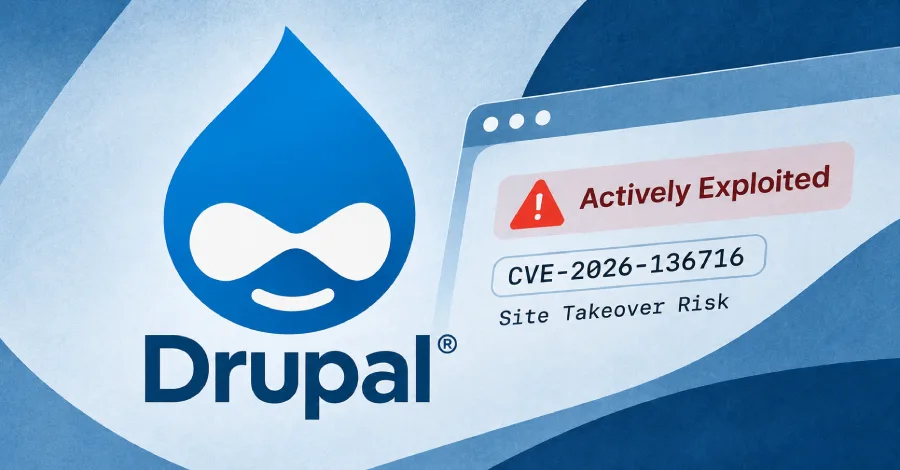
Drupal maintainers have issued an urgent warning regarding a “highly critical” security vulnerability in Drupal core that is currently being exploited in the wild. The flaw, tracked as CVE-2026-136716, allows unauthenticated attackers to perform a full site takeover under specific conditions.
The security issue is described as a case of improper checking for unusual or exceptional conditions. It is closely related to a previous vulnerability known as “Fail2Install” (CVE-2026-132165). Security researchers found that even after addressing the original flaw, certain Drupal installations remained in an incomplete or unusual install state that could be abused to gain administrative control.
Active Exploitation and Impact
The Drupal security team confirmed that the vulnerability is being actively exploited. One of the most significant challenges for administrators is that the vulnerable state is not apparent within the website’s user interface (UI). Furthermore, if a site has already been compromised, it may no longer appear vulnerable, complicating detection efforts.
The risk is highest for production sites that left their installer script (install.php) remotely accessible following previous security updates. Sites that have already secured their installer are reportedly not impacted by this specific exploitation vector.
Data indicates that out of approximately 55,800 internet-facing Drupal sites, more than 31,000 may be running versions vulnerable to the original installer flaws, making this latest development a broad threat to the ecosystem.
Recommended Updates and Mitigation
Security updates have been released for supported versions of the content management system (CMS). Administrators are urged to update to the following versions immediately:
- Drupal 11.4.14
- Drupal 11.3.23
- Drupal 10.6.23
Maintainers noted that Drupal versions 11.0.x through 11.2.x and Drupal 10.5.x and below have reached end-of-life (EOL) status and will not receive a security patch. Estimates suggest that approximately 15,000 Drupal sites are currently running these unsupported branches, leaving them permanently exposed to this threat unless migrated to a supported version.
Following the update, administrators should run update.php to remediate production sites. It is also recommended to audit site logs for any unauthorised changes to the “User 1” account, verify that the associated email address is under the owner’s control, and consider a password reset for high-privilege accounts.