



AI-Driven Attack Loops Require Transition to Stateful SOC Operations

Share
AI is significantly compressing the timeframe of cyberattacks by allowing adversaries to rapidly iterate through failed attempts. While the industry debates whether AI will create entirely new classes of attacks, a more immediate change is already occurring: AI is stripping the time and cost out of the research and troubleshooting phases of an intrusion.
An attacker landing on a low-privilege cloud account can now use a generative model to explain errors, fix failed scripts, and test new enumeration paths within minutes. This capability transforms the unglamorous middle of an intrusion—the research and troubleshooting that sits between intent and outcome—into a high-speed, automated process.
The Evolution of AI-Assisted Threats
The shift in attacker behaviour is already documented. Google Threat Intelligence Group (GTIG) observed that in early 2025, state-backed actors were primarily using generative AI as a productivity tool for translation and scripting. By late 2025, researchers identified malware samples that communicated with AI models mid-execution.
By May 2026, GTIG reported that cybercrime actors had used AI to support the discovery and exploit development of a two-factor authentication (2FA) bypass in an open-source administration tool. The trend indicates that AI is moving from being a tool that sits beside attacker workflows to being integrated directly inside them.
Closing the Defender’s Loop
Traditional attack lifecycles are often viewed as a linear progression from reconnaissance to impact. However, successful attackers operate in a continuous loop: they observe the environment, form a hypothesis, try an action, and immediately adjust based on the result. AI compresses the time between these steps, allowing both novices and experts to run more experiments per day.
Defenders are intended to operate in a similar loop, but modern Security Operations Centres (SOCs) often suffer from “decision latency.” This is frequently caused by a “lossy handshake” between the five core functions of security: threat intelligence, threat hunting, detection engineering, investigation, and remediation.
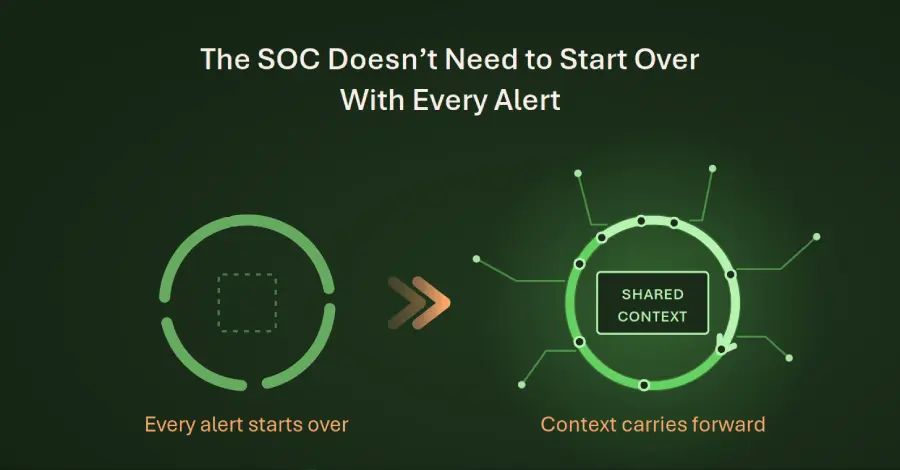
When information is transferred between these functions, critical context—such as entity identity, evidence provenance, and the reasoning behind a hypothesis—is often stripped away and replaced by a simple alert or ticket. This forces analysts to rebuild the incident history from scratch every time a new owner picks up the case.
The Shift to Stateful Security Operations
To counter AI-accelerated cyberattacks, security experts suggest that SOCs must move away from being “stateless” or amnesiac. Instead, they must adopt a stateful model that maintains shared operational memory across five critical areas:
- Environmental state: The relationships between identities, devices, workloads, and business services.
- Evidence state: The origin, timestamp, and source of every observation.
- Decision state: The current hypothesis and the alternative explanations being weighed.
- Control state: The authority required to take action and the potential business impact of those actions.
- Learning state: The corrections made by analysts and the resulting changes to detection logic.
By maintaining this shared state, an organization can ensure that when an analyst arrives at a case, the evidence-assembly process is already complete. This allows the analyst to focus on high-level reasoning and business context rather than manual data reconstruction.
This architectural requirement aligns with updated guidance from NIST SP 800-61r3, which recommends treating incident response as an integrated part of wider organisational risk management. As the attacker loop continues to tighten, the ability to maintain and share operational memory will be a primary differentiator in defensive efficacy.















Leave a Reply